

Use of Pumice Stone in the Construction Industry
Pumice stone, a natural building material of volcanic origin, is attracting increasing interest in the construction sector. This light and porous rock, formed as a result of volcanic eruptions, offers significant potential for various structural and insulation applications thanks to its unique physical and chemical properties. In particular, its qualities such as lightness, heat and sound insulation capacity, fire resistance and workability make it an attractive alternative to traditional building materials. Turkey hosts a significant portion of the world's pumice reserves, which creates a strategic advantage for the local construction sector. The availability of pumice from these rich local resources allows the development of sustainable and economical building solutions.
Physical Properties
The fundamental qualities that make pumice stone valuable for the construction industry stem from its unique physical structure.
Lightness and Density:
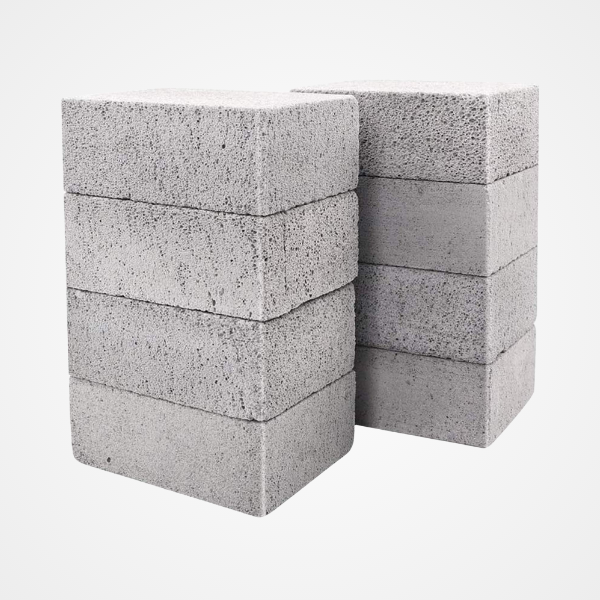
The most distinctive feature of pumice is its extraordinary lightness. This lightness is the result of the numerous gas cavities that are trapped within it during solidification. Its density is generally lower than that of water, typically below 1 gr/cm³ (e.g. 0.25 g/cm³, in the range of 0.5-1 gr/cm³), and therefore it can float in water. Its dry unit weight usually varies between 600-1500 kg/m³. This low density forms the basis for pumice's use as lightweight concrete aggregate, lightweight building blocks and lightweight filler material, significantly reducing the overall weight of structures.
Porosity:
Pumice has an extremely porous structure. 64-85% or 70-75% of its total volume can consist of voids. An important point is that the vast majority of these pores are unconnected. This unconnected void structure allows the material to largely block both heat and sound transmission. Therefore, the insulation performance of pumice depends not only on the total pore volume, but also on the internal structure and unconnected nature of these pores. This feature is particularly advantageous in insulation applications where moisture control is also important.
Hardness:
The value of pumice on the Mohs hardness scale is around 5-6. This hardness level indicates that pumice has a certain durability but is also workable (cuttable, shaped). However, this hardness and especially the high silica content is a factor that can cause wear in processing equipment.
Water Absorption:
Due to its porous structure, pumice stone has the ability to absorb water. The water absorption rate varies depending on the type of pumice and its pore structure, but is 20-30%. This property requires careful adjustment of the water/cement ratio in the design of pumice aggregate concrete mixes. In addition, the potential decrease in freeze-thaw resistance of pumice when saturated with water
Pumice Usage Areas and Advantages in the Construction Industry
The unique physical and chemical properties of pumice stone provide it with a wide range of uses in the construction industry. Its qualities such as lightness, insulation ability, durability and workability make it a suitable material for different structural and non-structural applications. This versatility shows that pumice is not a material that serves only one purpose, but has the potential to provide solutions to various needs and problems in different sub-disciplines of civil engineering thanks to its combination of properties.
Bims Blocks and Briquettes (Bims)
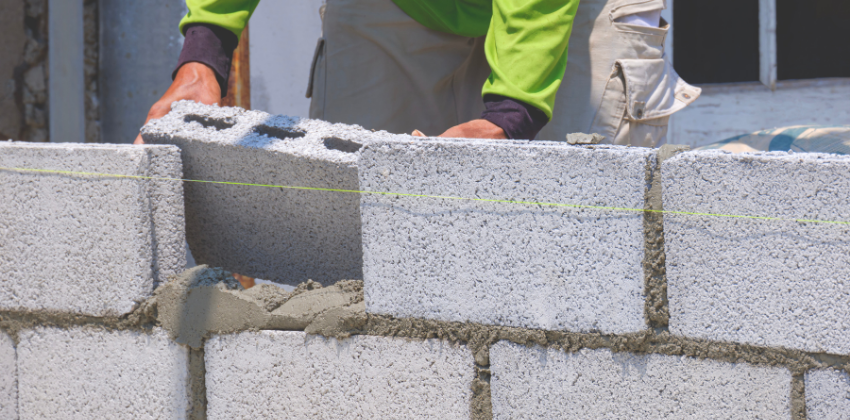
Lightweight construction elements produced in industrial facilities using pumice aggregate and widely used especially in walling are generally called "Pumice" or "Pumice Block" in Türkiye. These blocks are produced by mixing pumice aggregate, cement and water in certain proportions, pressing them in special molds and then curing (setting). The production process can be fully automatic, semi-automatic or manual depending on the automation level of the facility.
Bims blocks are produced in different types according to their purpose and place of use. These include solid or multi-cell (hollow) blocks used in interior and exterior walls, air conditioning blocks specially designed to increase thermal insulation, interlocking blocks that allow easy and mortarless vertical joints, hollow blocks used as filling material in floors, U blocks used to create lintels and joists, lintels and guide plates used at the beginning of the wall.
There are many reasons why pumice blocks are preferred in the construction sector. Among the most important advantages is the natural heat and sound insulation capacity resulting from pumice aggregate. This feature reduces or eliminates the need for additional insulation in buildings, thus providing savings in both initial investment and operating (heating/cooling) costs. Being lightweight, it reduces the total weight of the structures, alleviates earthquake loads and provides savings on the carrier system. The fact that the elasticity module of pumice blocks is lower than concrete helps them resist breakage and cracking by acting more flexibly during earthquakes. They are highly resistant to fire (generally A1 class non-flammable material) and do not emit harmful gases at high temperatures. Since they are produced from pumice, a natural material, they are environmentally friendly and healthy; thanks to their porous structure, they allow the walls to "breathe", regulating the moisture balance in interior spaces and preventing moisture formation. In addition, their easy workability (cutting, drilling, channel opening) and good adhesion with plaster provide ease of application and labor savings.
Bims blocks can be used in interior and exterior walls of all kinds of structures, partition walls, flooring systems (as hollow blocks), garden walls and even in chimney manufacturing.
Lightweight Concrete Aggregate
The most common and well-known use of pumice in the construction sector is as an aggregate (a filling material that replaces sand and gravel) in the production of lightweight concrete. It is reported that a large portion of the pumice mined in Türkiye (80-90%) is consumed for this purpose. Concrete produced using pumice aggregate is called "pumice concrete" or "lightweight concrete".
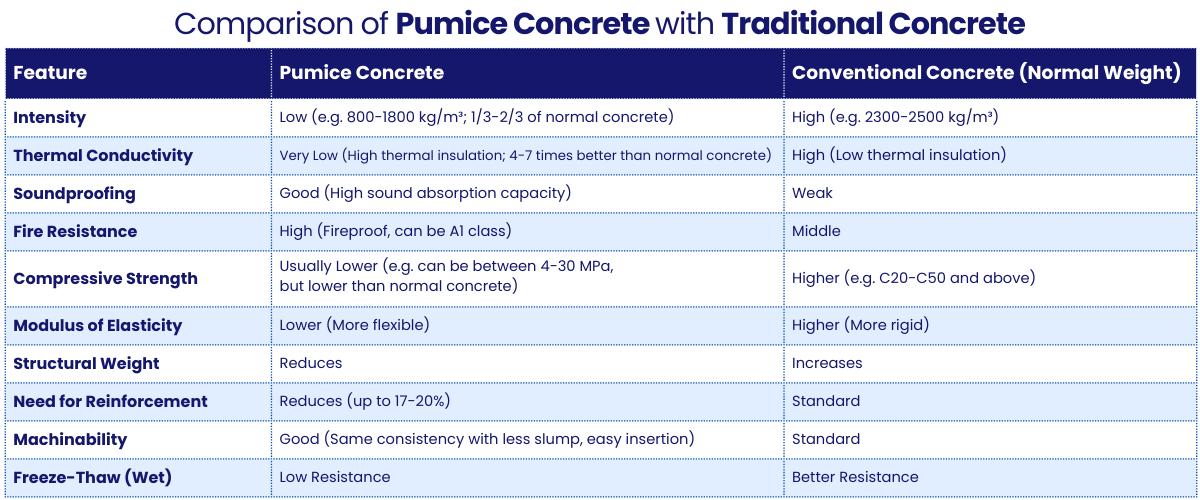
The most obvious advantage of pumice concrete over conventional (normal weight) concrete is its lightness. Since the density of pumice aggregate is about 1/3 to 2/3 of the density of normal sand and gravel, pumice concrete is also significantly lighter (30-50% or more) than conventional concrete. This lightness reduces the total dead load (self weight) of structures. The reduced dead load allows the design of foundations and load-bearing elements (columns, beams) with smaller cross-sections, which results in significant savings, especially in foundation costs and the amount of rebar used (up to 17-20%). In addition, lightness means ease of labor and time savings during the transportation of the material, its processing on site and placement in the formwork.
In addition to its lightness, pumice concrete offers superior insulation properties. Thanks to its porous structure, its thermal conductivity is quite low; it can provide 4 to 7 times better thermal insulation than traditional concrete. This increases energy efficiency in buildings and reduces heating and cooling costs. Similarly, pumice concrete has good sound insulation and sound absorption capacity, which increases acoustic comfort in spaces. Its fire resistance is also higher than traditional concrete; it can withstand high temperatures and does not emit harmful gases during fire. It is also stated that pumice concrete exhibits a more elastic behavior than normal concrete and therefore can perform better under earthquake loads.
Heat and Sound Insulation Applications
One of the most valuable features of pumice stone is its high heat and sound insulation ability, which is due to its natural structure. The numerous, usually unconnected air cavities inside the material create an effective insulation barrier by making it difficult for heat and sound waves to transmit. This feature allows pumice to be used in various insulation applications in the construction sector:
Wall Insulation: As mentioned above, pumice aggregate blocks provide significant thermal and acoustic insulation when used as wall elements. This can reduce or eliminate the need for additional insulation layers, especially on external walls. In addition, insulation can be provided by filling existing wall cavities with cast pumice aggregate.
Roof and Floor Insulation: Pumice aggregate can be used as loose fill insulation material in attics or floor slabs. Thanks to its lightness, it does not add additional load to the structure and its porous structure prevents heat transfer. It may need to be applied in certain thicknesses to provide the required insulation values according to thermal insulation regulations such as TS 825.
Pumice Alum: Lightweight pumice aggregate screeds (pumice screed) can be poured on floors, especially between floors or ground floor slabs, to provide heat and sound insulation. These screeds are lighter than traditional sand-cement screeds, provide better insulation and ease of application. Pumice screed creates a smooth sub-surface for the final floor covering (parquet, ceramics, etc.) to be placed on top, while also fulfilling the insulation function.
Free Fill: Insulation can be provided by freely filling bagged or bulk pumice aggregate in attics, cavities within walls or other hard-to-reach areas. This method can be a practical solution, especially for improving the insulation of existing structures.
The non-connected porous structure of pumice means that its insulation performance is not only due to its low density, but also to the material’s inherent microstructure. This structure reduces the formation of thermal bridges and helps dampen sound waves, thus improving both thermal and acoustic comfort.
Plaster and Mortar Aggregate
Pumice, in finely sieved or ground form, can be used in place of or together with sand aggregate in conventional plaster and mortar mixes. Plasters and mortars with pumice aggregate offer some distinct advantages over standard sand mixes.
Their lightness makes workmanship easier during application and reduces the load on the walls. The rough surface and porous structure of pumice provide good adhesion (sticking) with binders such as cement or lime, which helps the plaster to hold onto the wall better. Their easy workability allows plasterers to easily apply and shape the material.
Technically, it has been reported that pumice aggregate plasters can have higher compressive strength than sand plasters, and this difference in strength becomes more apparent especially after fire and freeze-thaw effects. It has also been stated that pumice aggregate mortars can be more resistant to cracking. One of their most important advantages is their contribution to heat and sound insulation. Plasters and mortars containing pumice aggregate improve the total insulation performance of the wall on which they are applied.
Geotechnical Applications
The low unit weight and good drainage properties of pumice make it a suitable material for a variety of geotechnical engineering applications.
Light Filling: The most important geotechnical use of pumice is as a lightweight filling material. It is used to reduce the load acting on the ground, especially under road fillings, bridge approach ramps or building foundations to be constructed on compressible soils with low bearing capacity. Being much lighter than traditional filling materials, it minimizes the settlements that will occur in the ground and reduces stability problems. In addition, when used as a lightweight filling behind retaining walls, it significantly reduces the lateral soil thrust acting on the wall.
Drainage: The high porosity and intergranular spaces of pumice provide good water drainage. Thanks to this feature, it can be used in drainage layers, agricultural drainage systems or other geotechnical applications where water needs to be removed.
Ground Improvement: Pumice is used in agriculture for soil improvement and can also potentially be used in soil stabilization. It can contribute to improving the engineering properties of weak soils, especially when mixed with binders such as lime, but a study has indicated that the fineness effect of pumice may be limited in this area.