

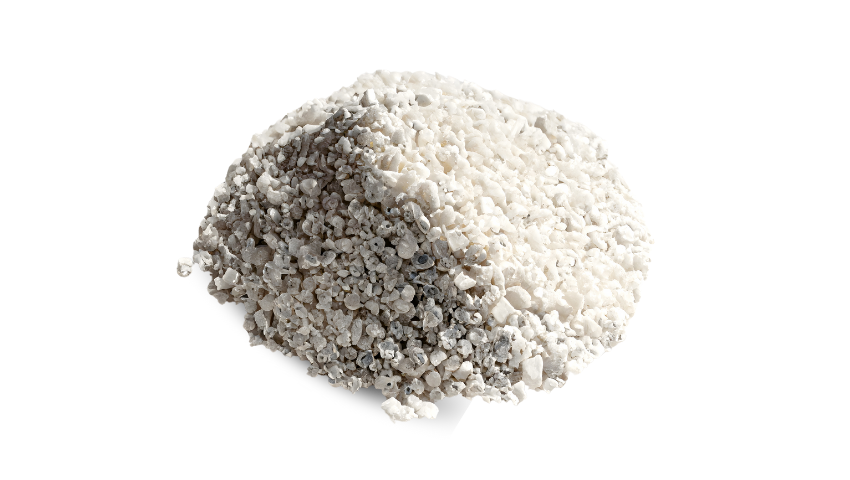
Nature's Versatile Volcanic Glass
What is Perlite?
Perlite is a naturally occurring volcanic glass that forms in the acidic (silica-rich) phase of magma. It is named after the French word "perlite", meaning "pearl stone", because of its ability to break into small, pearl-like globules when broken. Originally a volcanic rock like obsidian, perlite is usually found in shades of white or gray.
Perlite is distinguished from other volcanic glassy rocks, such as pumice, obsidian, and pecan, by its unique water content and ability to expand when heated. These unique properties make perlite a valuable raw material for many industrial and agricultural applications.
Geological Formation
The formation of perlite is directly related to volcanic activities. Silica (SiO2) is formed when acidic volcanic lava, such as rhyolitic or dacitic, rich in ), erupts onto the surface or cools and solidifies rapidly at shallow depths near the surface. This rapid cooling process occurs when the water molecules in the lava (H2O) cam yapısı içinde hapsolmasına neden olur. Tipik olarak %2 ila %6 arasında değişen bu bağlı su içeriği, perlitin en karakteristik özelliklerinden biri olan genleşme kabiliyetinin temelini oluşturur. Volkanik patlamalar sırasında erimiş lavın yeryüzüne çıkması ve ani soğumasıyla oluşan bu camsı yapı, içindeki su molekülleriyle birlikte perliti tanımlar.
Basic Properties of Perlite
The unique applications of perlite arise from its unique physical and chemical properties.
Chemical Composition:
Perlite is basically composed of amorphous silicon dioxide (SiO2) is an aluminum silicate consisting of 65-75% SiO2 and 10-16% Aluminum Oxide (Al2O3) In addition, it contains lower amounts of Sodium Oxide (Na2O, 1.8-8%), Potassium Oxide (K2O, 3-5%) and trace amounts of Iron Oxide (Fe2O3), It also contains compounds such as Calcium Oxide (CaO) and Magnesium Oxide (MgO).
Bound Water Content:
The distinguishing feature of perlite is that it contains chemically bound water in its structure, varying between 2% and 6%. This water is the key factor that allows perlite to expand when heated.
pH Neutrality:
Perlite has a neutral pH value, generally ranging between 6.5 and 7.5. This feature provides a great advantage in that it does not change the acidity or alkalinity of the medium, especially in pH-sensitive applications such as agriculture and filtration.
Chemical Inertness/Stability:
Perlite is a chemically very stable and inert material. It does not react with most acids, bases and other chemicals and is insoluble in water. Therefore, it can be used safely with different materials such as plasters, filter aids, textile processes. In addition, it does not contain nitrate, sulfate, phosphorus, heavy metals, radioactive elements and organic substances, indicating its chemical purity.
Sterile Structure:
Due to its volcanic origin and the high temperatures (and also the expansion process) during its formation, perlite is naturally sterile. It does not contain bacteria, fungi, insects or weed seeds. This feature is critical, especially in food, pharmaceutical filtration and agricultural applications (seedling cultivation, soilless agriculture) in terms of eliminating the risk of contamination.
Durability/Longevity:
Since perlite is an inorganic mineral, it does not deteriorate, rot or decompose over time. This provides long-term performance in applications such as soil regulation and insulation.
Hardness:
Although raw perlite has a fragile and hand-crumbly structure, SiO2 gives it a certain abrasiveness. Expanded perlite grains, despite being light, have a certain structural integrity.
Expansion Process and Its Effect on Properties
The most important process that reveals the commercial value of perlite is the expansion process. This process radically changes the physical properties of the material.
Mechanism:
When raw perlite ore is suddenly heated to high temperatures of 750-1200°C (typically 850-1100°C) in specially designed furnaces (usually vertical furnaces), the 2-6% bound water in its structure evaporates rapidly. The volcanic glass, which has reached its softening point, expands like popcorn under the effect of this sudden steam pressure, and countless microscopic bubbles or pores are formed inside. The process usually includes a preheating step at approximately 180-350°C to remove loosely bound water.
Volume Increase:
As a result of this expansion process, perlite can expand 4 to 20 times its initial volume, and in some cases even up to 35 times.
Density Decrease:
This large increase in volume results in a significant decrease in density. While the density of raw perlite is in the range of 960-1400 kg/m³, the density of expanded perlite can vary between 30 kg/m³ and 600 kg/m³, depending on the degree of expansion and the intended application. This makes expanded perlite an extremely light material.
Increased Porosity:
The internal bubbles formed during expansion give perlite a very high porosity that can exceed 90%. This porous structure is key to perlite’s basic functions such as insulation, water management and filtration. Aeration porosity is usually around 60%.
Improvement of Insulation Ability:
The air trapped inside the pores makes expanded perlite an excellent heat and sound insulator. Its heat conduction coefficient is quite low (approximately 0.04 W/mK or 0.035 Kcal/mh°C). In this way, it minimizes heat loss and gain in buildings and industrial applications. At the same time, the porous structure provides effective sound insulation by absorbing or damping sound waves.
Surface Area Increase:
The formation of internal pores significantly increases the effective surface area of the material. This feature increases the performance of perlite, especially in filtration applications.
The expansion process is essentially a physical transformation triggered by the evaporation of water in the perlite structure. The absence of complex chemical reactions contributes to the relative simplicity of the process and the chemical stability of expanded perlite. This physical nature is different from processes that require chemical decomposition, such as cement production, or processes based on chemical reactions, such as the production of some synthetic materials.
Unique Advantages of Perlite
The properties it gains through the expansion process offer perlite unique advantages in many areas.
Lightness and Structural Benefits
One of the most obvious advantages of expanded perlite is its extraordinary lightness. Thanks to its high porosity, its density can be reduced to very low values such as 30-100 kg/m³. This lightness provides significant benefits, especially in the construction sector:
- Reducing Building Load: Perlite concrete, plaster and other building elements are much lighter than traditional materials. This significantly reduces the dead load on the foundation and load-bearing systems of buildings. For example, using perlite instead of sand in the plaster of a 100 m² apartment can reduce the load on the structure by 8-9 tons.
- Material Savings: Reduced structural loads allow for smaller foundation sizes and a reduction in the amount of steel reinforcement used in load-bearing systems (savings of approximately 15-17%), which directly reduces material costs.
- Earthquake Safety: Reducing the total weight of the structure reduces the lateral forces (inertia forces) acting on the building during an earthquake, which increases the earthquake resistance of the structure.
- Ease of Application: The lightness of the material facilitates transportation, storage and application processes and can reduce labor costs and time.
Superior Heat and Sound Insulation
The porous structure that perlite gains during expansion makes it an excellent insulation material:
- Heat insulation: It largely prevents heat transfer thanks to the trapped air pockets inside. It has a very low thermal conductivity coefficient (approximately 0.04 W/mK). This feature can provide energy savings of 30% to 50% by reducing heat loss and gain in buildings. For example, a 2 cm thick perlite plaster can provide performance equivalent to the thermal insulation provided by a 10 cm thick brick wall. This both increases indoor comfort and significantly reduces heating and cooling costs.
- Soundproofing: The porous structure also provides effective sound insulation by absorbing or damping sound waves. It is particularly effective in reducing high-frequency sounds and impact sounds. This helps create a quieter and more peaceful environment in homes, offices and other spaces where noise is a problem.
Due to these insulation properties, perlite is widely used in plasters, screeds, lightweight concretes, as loose filling material in wall cavities, attics, roofs and floors, insulation boards and even in the insulation of cryogenic (very low temperature) tanks.
High Fire Resistance
The inorganic structure of perlite gives it excellent fire resistance:
- Flammability: Perlite is a class A1 fireproof material. It does not burn, does not catch fire, and does not emit toxic gases when exposed to fire.
- High Temperature Resistance: It can withstand very high temperatures. Its softening point is above 850°C and can be used at temperatures up to 1000°C.
- Security Contribution: Thanks to these properties, perlite is used in applications such as fire-resistant plasters, concretes, spray coatings, chimney fillings and fire protection of steel constructions, significantly increasing the fire safety of buildings.
Effective Water Management: Drainage and Aeration
Especially in agricultural and horticultural applications, the porous structure of perlite offers significant advantages in terms of water management:
- Soil Aeration and Drainage: When mixed into the soil, expanded perlite prevents soil compaction, creates air pockets that allow roots to breathe better, and helps excess water drain. This is especially beneficial in heavy, clayey soils and for plants that are susceptible to root rot (e.g. succulents).
- Water Retention Capacity: While improving drainage, it can also hold a significant amount of water within its pores (up to 4 times its weight or 35-50% of its volume). It gradually releases this water to the plant roots, allowing for longer irrigation intervals and water savings.
- Application Areas: Thanks to these properties, perlite is widely used in soilless agriculture (hydroponic) systems, seed germination and seedling growing media, rooting cuttings and improving garden soil and potting mortars.
Chemical Stability and Sterile Structure
As previously detailed (Section II.A), perlite is chemically inert, pH neutral and sterile, which are important advantages that expand its areas of use and increase its reliability.
- Reliability: These features prevent perlite from negatively affecting the environment or product it is used in. It does not leave a taste or odor in filtration processes, does not change soil pH in agriculture or carry harmful organisms, and does not react chemically with the products in which it is used as a filling material.
- Durability: Thanks to its inorganic structure, it does not rot, deteriorate, or harbor pests or rodents. This allows it to offer long-lasting and maintenance-free solutions.
The fact that perlite offers many basic features such as lightness, insulation, fire resistance and chemical stability makes it a multifunctional and valuable material, especially for the construction sector. The ability to meet more than one performance criterion with a single material (for example, providing lightness, heat/sound insulation and fire resistance with perlite plaster) increases the overall building performance by simplifying the design and application processes. This is a significant advantage over materials that are superior in only one area.
Wide Areas of Use of Perlite
The unique properties of perlite provide it with a wide range of uses, from construction to agriculture, from filtration to industrial processes.
Perlite in the Construction Industry
The most common use of expanded perlite is the construction sector, and a significant portion of the perlite produced (more than 50% or 80% according to some sources) is used in this sector.
- Lightweight Concrete and Mortar Aggregate: Perlite is used as an aggregate in the production of lightweight concrete, plaster and screed by mixing it with cement or gypsum binders. These products both reduce the weight of the structure and provide heat and sound insulation.
- Insulated Plasters and Screeds: Perlite plasters used on interior and exterior facades and perlite screeds used on floors provide effective heat and sound insulation to buildings. Thanks to their breathable structures, they help prevent moisture formation.
- Loose Fill Insulation: Expanded perlite grains are used for heat and sound insulation in wall cavities, attics, floors and roofs by the free pouring (loose filling) method. Specially treated perlite (e.g. silicone) can also be used in foam form. Ready-made perlite insulation boards or mats are also available.
- Fire Protection: Perlite increases the fire resistance of building elements (especially steel constructions) by being used in fire-resistant spray coatings, plasters, concretes and special panels.
- Other Building Applications: It is also used in various special construction applications such as perlite lightweight building elements (ceiling tiles, wall blocks, panels), acoustic sprays/panels, chimney and fireplace fillings, perlite roof tiles. Raw perlite can also be used as an additive in cement production.
Perlite in Agriculture and Horticulture
The porous structure that perlite gains during expansion makes it an excellent insulation material:
- Heat insulation: It largely prevents heat transfer thanks to the trapped air pockets inside. It has a very low thermal conductivity coefficient (approximately 0.04 W/mK). This feature can provide energy savings of 30% to 50% by reducing heat loss and gain in buildings. For example, a 2 cm thick perlite plaster can provide performance equivalent to the thermal insulation provided by a 10 cm thick brick wall. This both increases indoor comfort and significantly reduces heating and cooling costs.
- Soundproofing: The porous structure also provides effective sound insulation by absorbing or damping sound waves. It is particularly effective in reducing high-frequency sounds and impact sounds. This helps create a quieter and more peaceful environment in homes, offices and other spaces where noise is a problem.
Due to these insulation properties, perlite is widely used in plasters, screeds, lightweight concretes, as loose filling material in wall cavities, attics, roofs and floors, insulation boards and even in the insulation of cryogenic (very low temperature) tanks.
Perlite in Filtration Solutions
Expanded perlite is used in many industries as an effective filter aid due to its unique physical structure and chemical inertness.
- Function as a Filter Assistant: It forms a porous cake layer on the filter surface (e.g. on a filter cloth) to retain solid particles in the liquid. This layer allows the liquid to flow at high speeds while retaining even very fine particles (down to 0.1 microns). It prevents clogging of the filter elements and prolongs the duration of the filtration cycle.
- Application Areas: It is widely used in the food and beverage industry (beer, wine, fruit juices, edible oils, sugar syrups), the pharmaceutical industry (antibiotics, pectin), the chemical industry (acids, sodium silicate, dyes) and water treatment (drinking water, pool water, wastewater).
- Advantages: Perlite filter aids are inert, meaning they do not impair the taste, odor or chemical structure of the filtered liquid. They are sterile, which is important for food and pharmaceutical applications. Their light weight allows the filter cake to be easily cleaned and can reduce disposal costs. They are an effective, economical and readily available material.
Perlite in Industrial Applications
The thermal properties, lightness and inert structure of perlite also make it valuable for various industrial processes.
- Cryogenic Insulation: It is widely used in the insulation of double-walled tanks where liquefied gases (LNG, LPG, liquid nitrogen, liquid oxygen, etc.) are stored and transported at very low temperatures (down to -270°C). It helps gases remain in liquid form by providing excellent thermal insulation and minimizes evaporation losses.
- High Temperature Insulation and Refractories: Thanks to its high melting point and low thermal conductivity, it is used in the insulation of industrial furnaces, crucibles, reactors and in the production of refractory (fire-resistant) bricks, concrete and mortars. In foundry, it is used to prevent heat loss by covering the molten metal (ladle topping), to collect slag and as a molding sand additive.
- Filling Material: It is used as a filler in plastics, rubbers, paints, varnishes, putties, adhesives and sealants due to its lightness, inertness and, in some cases, the texture it provides. It reduces the density of the product, increases its volume, reduces cost and sometimes improves heat resistance or workability.
- Textile: It is used in the washing process to obtain the "stone washed" appearance of denim fabrics such as jeans. It is stated that it is less abrasive than pumice stone and causes less damage to the fabric and machines. It also has the advantages of not reacting with chemicals and being light.
- Abrasives: Thanks to its soft abrasive properties, it is used in hand cleaners, scouring powders, polishes, toothpastes and cosmetic peeling products. (Note: While it is stated that it is not abrasive in textile applications, its use as an abrasive in other areas emphasizes the importance of grain size and application method).
Oil and Gas Well Cementing: It can be added as an additive to mortars used in cementing oil and gas wells to provide lightness, insulation and fluidity control. There are cases where it is used together with cenospheres or as an alternative.
Other Niche Uses: It is also used in a wide variety of other areas such as carrier for pesticides and herbicides, absorbent material for spilled liquids (especially oils), packaging filler for sensitive products, additive in the production of explosives, additive in the ceramic and glass industry, evaporation reducing cover in dam lakes, and ship caulking putties.
It is noteworthy that perlite can function in an extremely wide temperature range, from cryogenic applications of -270°C to casting and refractory applications exceeding +1000°C. This extraordinary thermal versatility is a direct result of perlite’s stable, inorganic and porous structure, which is formed by expansion. Unlike organic materials, it does not deteriorate at high temperatures, and unlike metals, it does not conduct heat well; thus, it successfully performs its insulating function in both extreme cold and extreme heat.